

Riverine flooding information for Quamby Brook
Version 1.0 January 2026
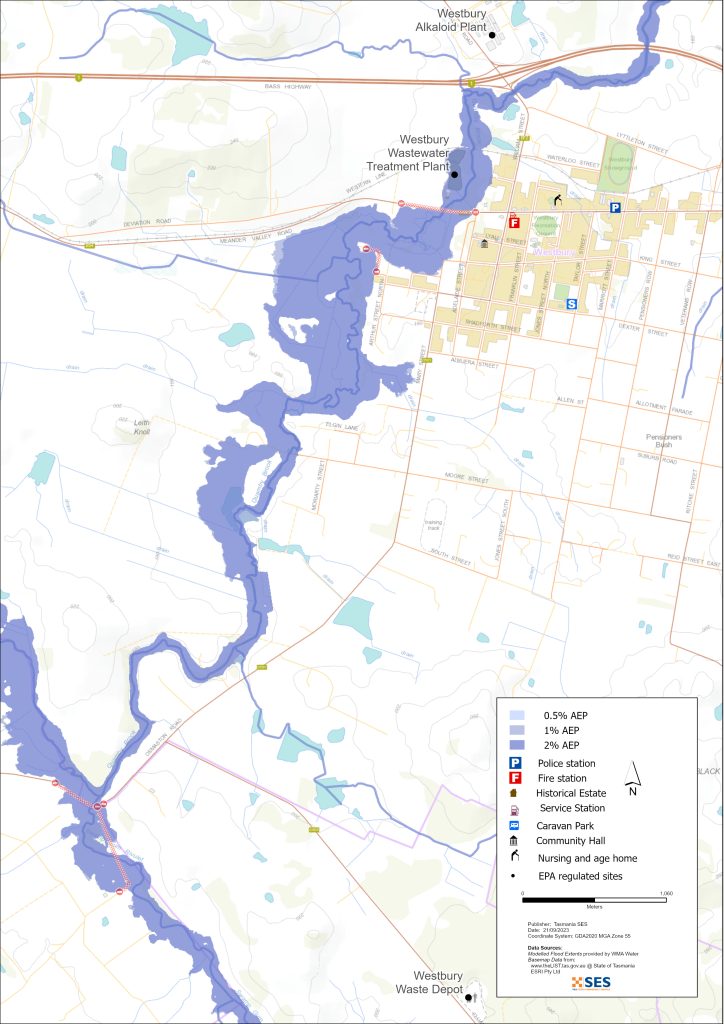
To see the maps in more detail, see the Tasmanian Strategic Flood Maps.
Quamby Brook can flood
- Westbury
- Quamby Brook
- Golden Valley, and
- Cluan.
The map shows the expected Moderate and Major Flood levels in and around Westbury. You are likely to experience a major flood in your lifetime.
To see the maps in more detail, see the Tasmanian Strategic Flood Maps – go to the SES website.
In a major flooding event, roads in and around Westbury and surrounds are likely to be cut and some areas inundated. If you need to evacuate, you should leave early, before flood waters rise. Listen to ABC local radio for warnings and advice.
In such flooding events, the Westbury area may be isolated due to flooding of
- the Meander Valley Road
- Birralee Road and
- Osmaston Road.
Flooding, landslips or fallen trees may also cut minor roads. It is dangerous to drive through flooded roads, particularly in isolated areas.
Even if your home is not inundated, you may be isolated for several days. You should have supplies for up to three days and be prepared for power and telecommunications outages. Note if you are isolated, you may not be able to access medical or other help if needed.
Are you at risk of flood?
Example past flooding events around Westbury include:
- In June 2016 properties and roads were impacted by flood waters around Westbury. There was extensive flooding across the Meander Valley area damaging buildings, roads, and bridges.
- In October 2022 Quamby Brook flooding local roads and isolated several properties.
What should I do?
- Check the map to see whether your home or business is likely to be at risk during a flood.
- Check if you might not be able to safely get to your home, work, or school during a flood.
- Prepare a Home Emergency Plan. Consider if you need to evacuate before a flood. See Get Ready for Emergencies – A guide for individuals and households to prepare for emergencies.
- Assess your home or business and prepare it to minimise possible flood damage.
Bureau of Meteorology (BoM) Forecasts, Warnings, and Observations
BoM issues a Flood Watch when predicted weather might cause floods in one or two days. A Flood Watch may
- be for a specific area such as Deloraine, or
- be generalised such as for Great Western Tiers, Central Plateau or Central North forecast district.
BoM issues a Severe Weather Warning for very heavy rain that may lead to flash flooding whenever this weather is occurring or is expected in an area. The amount of time between the warning and the arrival of heavy rain can vary from an hour to 24 hours or sometimes more.
There are no gauging stations in the Quamby Brook catchment to support BoM to issue Flood Warnings with specific flood heights for Quamby Brook.
No two floods are the same. Floods like the one shown in the map or worse will occur again.
If you live in a low-lying area you may be at risk of flooding. Even if your home is safe, you may need to detour around flooded areas. Never drive through or enter flood waters.
Knowing what to do can save your life and help protect your property. Preparing a Home Emergency Plan is one of the best ways to prepare.
Include weather and rainfall triggers for action in your Home Emergency Plan.
Flood levels for Westbury and surrounds
While no two floods are the same, the following table shows what you can expect at different flood levels around Meander. Even if your property is not flooded, you need to think about access routes.
Minor
- Flooding is largely contained to the river channel with some minor breakouts into adjacent paddocks.
- Livestock and agricultural equipment should be moved from low lying areas near the river.
- There are no buildings at risk of inundation.
- No properties are isolated
- There are no roads inundated.
Moderate
- Water spills over riverbanks and covers larger areas of land.
- Westbury Town Common open space area is flooded
- Livestock and agricultural equipment should be moved from low lying land
- Some homes along Field Street may become surrounded by shallow flood waters.
- Above floor flooding is unlikely
- Isolation of some rural properties as access roads become flooded.
- Flooding may close road sections:
- Osmaston Road
- Moore Street
- Field Street
- Birralee Road
- Selbourne Road
- Bogan Road
- Quamby Brook Road
- Golden Valley Road
- Cluan Road
Major
- Widespread flooding into the floodplain, impacting some homes and buildings with above floor flooding.
- Livestock and agricultural equipment should be moved to the highest areas available.
- Above floor flooding is likely for some homes and buildings along Mary Street, Lonsdale Street and Field Street.
- There are increased numbers of rural properties isolated.
- Meander Valley Road is likely to be closed.
Know your risk, get ready, reduce risk where you can, connect with others, stay alert and act safe.
Before a flood
1. Know your risk
Flooding often happens in Tasmania and can cause widespread and significant damage. In the past 200 years there have been 78 flood related deaths in Tasmania. This guide is to help you understand flood risk in your area.
2. Prepare your household
Have an emergency plan that covers storms and floods
Thinking about what you would do in a storm or flood means you are more prepared and everyone is safer. Have an emergency plan that everyone in your household understands. There are checklists to help you think through your plan – see Get Ready for Emergencies – A guide for individuals and households to prepare for emergencies.
Check your plan regularly and test it by everyone in the household thinking through a flooding scenario that may affect your household.
Prepare an Emergency Kit
Ready to Go
- Battery powered radio and torch, spare batteries
- Important information, such as your emergency plan
- A list of emergency numbers
- Food and water
- First aid kit
- Rubber or strong leather gloves
Pack when needed
- Warm clothes, sturdy shoes or boots
- Medicine, glasses or other essential items
- Mobile phone and phone charger
- Pet food and anything else they need
- Photos and special keepsakes
- Money
- Important documents, for example
- insurance papers
- passports and
- birth certificates
Regularly test batteries in radios and torches.
3. Reduce your risk from flooding where you can
- Think about storms, flooding and other hazards when buying, maintaining or developing property.
- Trim or remove trees and branches overhanging your home, business or near powerlines on your property.
- Keep your gutters and drains clear.
4. Connect with others
Know your neighbours and get involved in your community. A connected community is a safer and more resilient community in an emergency and can help everyone recover better afterwards. Check that family and neighbours are safe and aware of what’s happening.
During
5. Keep up to date
Keep aware of what is happening around you. Check forecasts, observations and warnings regularly.
- TasALERT.com
- your local ABC radio station or
- the Bureau of Meteorology’s website.
 |
Advice (Yellow): an incident has started. There is no immediate danger. Stay up to date in case the situation changes. |
 |
Watch and Act (Orange): There is a heightened level of threat. Conditions are changing and you need to start taking action now to protect you and your family |
 |
Emergency Warning (Red): An Emergency Warning is the highest level of warning. You may be in danger and need to take action immediately. Any delay now puts your life at risk. |
 |
Community update (Blue): Specific information and updates for affected communities regarding a particular event or incident. |
 |
Incident (White): an incident is the initial occurrence of an event before it becomes an emergency warning. As soon as an incident is reported, TasALERT publishes basic information including the type and location of incident. |
For more information see www.ses.tas.gov.au/warnings/ .
6. Act Safe
- Supervise children.
- Prepare for possible power, water or internet outages.
- Check your emergency kit is ready to go.
- Keep clear of flooded areas such as drains. NEVER walk, play, ride or drive in floodwater. You can’t always see what is under the water or how deep or fast-moving the water is. It is easy to be swept away and drown in as little as 20cm of fast-moving water. Flood water can be dangerous.
When your home may be flooded
- Put household items up high to minimise possible damage.
- Turn off the electricity and gas if it is safe to do so.
- A great way to stop sewerage flowing back into your home is to place sandbags inside plastic bags and use them to block toilets and cover drains and sinks.
- Leave while you can get out safely.
If you need to evacuate
- Follow the advice from SES / Tasmania Police.
- Take your emergency kit.
- Go to friends or family in a safer place or an evacuation centre.
- Let others know where you have gone.
Look after your animals
You are responsible for your animals in an emergency. If you have pets and other animals it will take you longer to evacuate in a flood or other emergency. Move livestock from flood prone areas well before flood waters may rise. For more information see
- RSPCA’s guidance on preparing for animals in an emergency
- the Primary producer farm flood readiness toolkit.
Avoid travelling during storms and after storms
- Do not go sightseeing. Sightseers delay emergency services and cause accidents.
- Watch out for hazards such as
- water over roads
- damaged powerlines
- landslides
- damaged roads
- falling trees or roofing iron.
- Never drive through flood waters. Most deaths and rescues in floods are from people driving through flood waters.
- Drive slowly and turn your headlights on roads not affected by flood waters.
After
- Keep listening for ABC Local Radio updates, road re-openings, community meetings, etc.
- If you left your home, do not return home until SES or Tasmania Police tell you it is safe to do so.
- Be aware of road hazards, such as mud or debris on the road, damaged roads/bridges and crews working on clean-up and repairs.
If your home has been damaged
- Stay at ground level while checking for damage. Be careful of fallen trees, broken glass, loose roofing or other hazards.
- Wear strong boots, gloves and protective clothes.
- Use a torch, never use matches or candles inside flood affected buildings.
- Boil all drinking water until you are told the tap water is safe again.
- Do not turn on electricity or gas until it is tested by a licensed electrician or gas fitter for safety.
- If your home is damaged and you need to stay somewhere else, take your emergency kit and pets with you
- Take photos of any damage if safe for you to do so and contact your insurance company.
- Supervise children.
- Check neighbours are okay.
For further information go to www.ses.tas.gov.au .
Staying informed and further information
Current warnings (TasALERT) TasALERT.com
Bureau of Meteorology (BoM) bom.gov.au/tas/warnings
Emergency Broadcasters ABC 91.7FM
TASSES Social Media facebook.com/sestasmania
Preparing for Flood Emergencies ses.tas.gov.au/ flood-plan/
Meander Valley Council meander.tas.gov.au 6393 5300
National Relay Service (NRS) relayservice.gov.au
