
Incident Management in Tasmania
Incident management systems provide a structured framework for managing incidents and emergencies.
In Tasmania, most organisations develop standard operating procedures that provide good practice guidelines for management and resolving emergency operational response situations. Incident management systems establish a structured and common approach to incident management. These systems include common terminology, a scalable planning process and organisational structures to match the size, impact and complexity of an incident.
Many organisations in Tasmania use incident management systems based on the Australasian Inter-service Incident Management System (AIIMS).
Tasmania Police uses the Incident Command and Control System Plus (ICC+), which aligns with policing arrangements used across Australia.
While incident management systems may vary between organisations, they provide a common approach to managing incidents through clear roles, responsibilities, coordination and information sharing.
Incident Control and Coordination Facilities
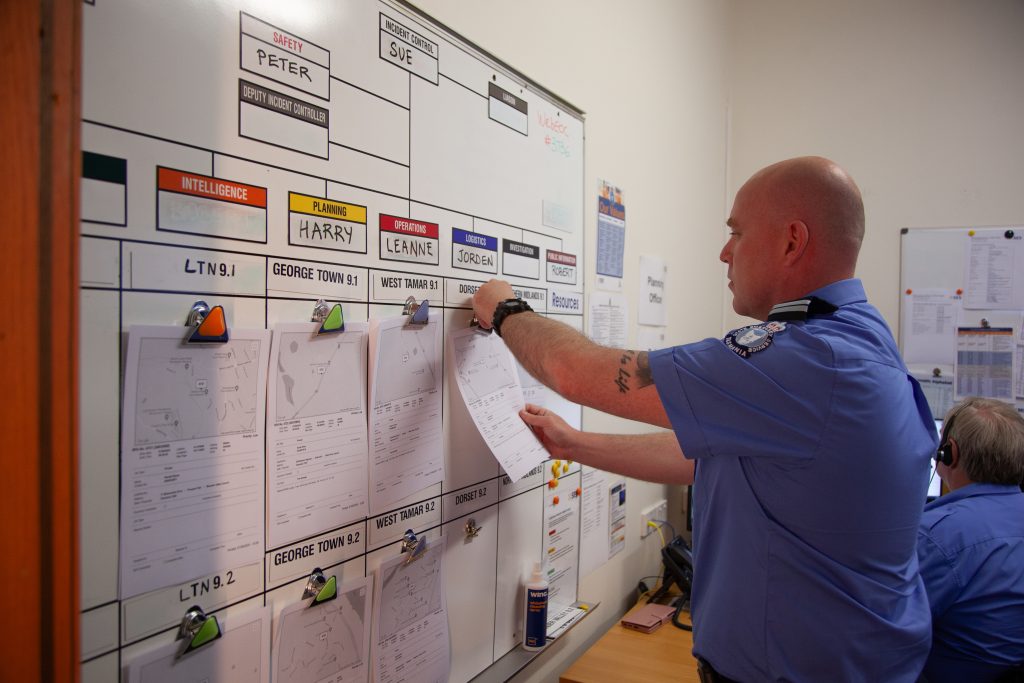
As emergencies increase in scale and complexity, different facilities may be established to support both the management of the incident and its broader impacts.
Incident Control Centres (ICCs) are typically established by the RMA to manage and resolve the incident itself. Other organisations may establish Emergency Operations Centres (EOCs) to support their own operational decision-making, resource management and agency activities. Emergency Coordination Centres (ECCs) support coordination across agencies and organisations, including consequence management, resource coordination and the transition to recovery.
The primary differences between the functions carried out at an ICC, EOC and ECC are:
ICC / EOC
| ❯ | Sets objectives and determines strategies and tactics to resolve the incident or specific aspects of the incident. |
| ❯ | Allocates, deploys and manages resources to support the tactical and operational response. |
| ❯ | Usually agency-specific, with the Response Management Authority establishing the Incident Control Centre and supporting agencies establishing their own Emergency Operations Centres. |
| ❯ | Provides operational information about the incident to the public and media. |
ECC
| ❯ | Sets objectives and determines strategies and tactics to manage the consequences of an emergency. |
| ❯ | Allocates, deploys and manages resources to address the consequences of an emergency. |
| ❯ | Staffed by an Emergency Management Team (EMT) and agency Liaison Officers and Advisors. |
| ❯ | Coordinates and disseminates public information about emergency consequences and the transition to recovery. |
While these facilities perform different functions, they work together to support effective incident management, response coordination and consequence management. Their roles and responsibilities are explored later in this module.
オーストラリア・ニュージーランド統合部隊インシデント管理システム
Managing the response to a large emergency incident is one of the more complex tasks undertaken by human organisations. AIIMS has been developed to assist in this process, and to provide some order. AIIMS has been the foundation of Command and Control doctrine for fire and emergency services in Australia and New Zealand for over 30 years. It is based on five key principles and provides a consistent approach to managing incidents:
| ❯ | Safety – The safety and welfare of responders, supporting agencies and impacted communities is a primary responsibility of the Incident Controller and incident management team. |
| ❯ | Flexibility – AIIMS is designed to be adaptable within an all-hazards, all-agencies environment and to respond to changing incident circumstances. |
| ❯ | Management by Objectives – Incident activities are directed through clearly defined objectives, strategies and actions that support the desired outcome. |
| ❯ | Functional Management – Incident management activities are organised into functional areas to support effective coordination and management. |
| ❯ | Span of Control – Supervisors maintain responsibility for a manageable number of personnel and resources to support effective oversight and decision-making. |
Areas of Operation, Interest and Consequence
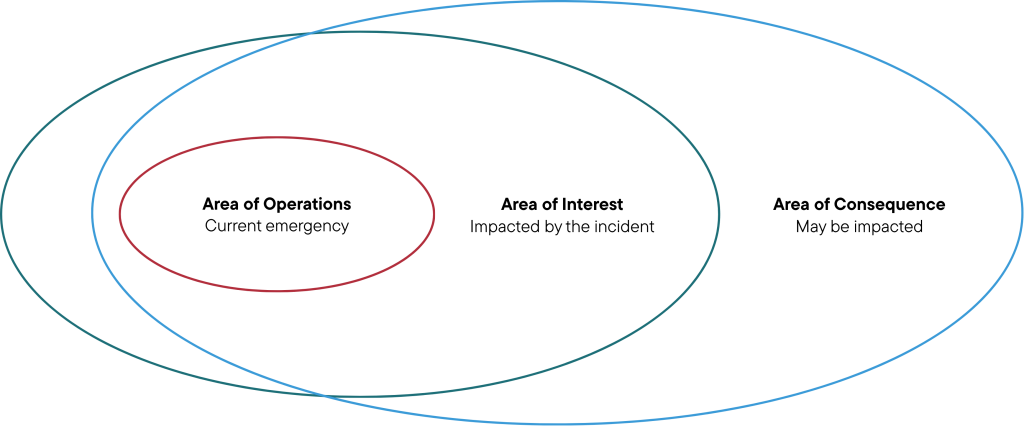
To support effective situational awareness and decision-making, emergency managers consider incidents across three related perspectives.
| ❯ | Area of Operations: The geographic area where response activities are being conducted and resources are actively engaged in managing the incident. |
| ❯ | Area of Interest: The broader area that may influence or be affected by the incident and requires monitoring, information gathering and situational awareness. |
| ❯ | Area of Consequence: The area where the actual or potential effects and impacts of the incident are experienced by communities, infrastructure, the environment or other assets. |
Further Reading